
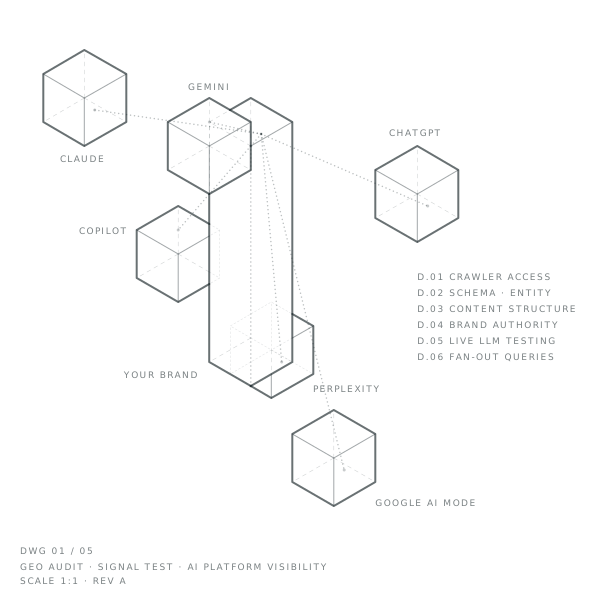


An SEO audit tells you where you rank on Google's ten blue links. A GEO audit tells you whether you show up at all when buyers ask an AI assistant about your category. They answer different questions.
Ask them which of the six layers they run. Most SEO teams are built for Google rank and haven't rebuilt their process for how AI retrieval works. What gets you cited there is extractability and entity authority. Position on a results page is a separate question. If they can name the six layers and show you their fan-out and citation work, use them. If you get a vague answer, that's the gap this fills.
It depends on your category. If you sell B2B software with a long, research-heavy buying cycle, AI citations are already shaping who makes the shortlist. If you sell something cheap and fast, the effect is smaller and further off. The audit gives you a straight read for where you actually sit.
The quick wins usually show up in 2–4 weeks. The slow ones, like building entity authority and earning third-party mentions, compound over 3–6 months. The audit tells you which fix is which.
If traffic isn't converting, CRO first. If you have decent conversion but suspect AI is recommending competitors instead of you, GEO first. Same price either way. If unsure, send a URL and get a straight answer back.
A URL and a sentence about what you sell and who you sell it to, a short kickoff call so I understand your buyer, and two or three competitor URLs. Read-only GSC access helps with Layer 6, the fan-out work. If it's slow or you can't get it, the audit still ships on time with five of the six layers. Layer 6 follows once access clears.
Yes, as a separate engagement, scoped after you've seen the findings. A lot of clients just take the fix list to their own developer or SEO team. Either way works.
Enterprise agency GEO retainers start at $3,000 a month. This is a senior practitioner running your category live across the major assistants and handing you a scored, prioritized fix list in seven days. Roughly the cost of one trade show badge.
A tool checks one of the six layers, the live test, and even that it gets wrong often enough to matter. Independent tests have caught trackers reporting a handful of mentions when the real count was over a hundred. The $2,000-a-month platforms just add more assistants to scan. None of them can tell you why the authority you paid for isn't reaching the answer, or what to fix first. A tool tells you that you're missing. It can't tell you why, and it can't tell you what to do about it.
Then you get a short report, a straight "don't spend on this right now," and the 30-day plan becomes a light monitoring cadence. We still do the debrief. You paid for certainty, and that's what you get.
Twenty years of B2B digital, including recent work for Moderna, J&J, Sapient, TATAA Biocenter, PlanHub, and Georgia Pacific. I'm NN/g trained with a Harvard GSD background. My most recent full CRO engagement delivered 10× organic traffic and tripled conversions.
You run marketing or growth at a B2B company doing $2M–$200M. You've already put money into traffic, SEO, paid, content, and the conversion side hasn't kept up. You want a diagnosis you can act on this quarter. A six-month engagement that hands you a deck in month three is the opposite of what you need.