
Custom-Bilt Metals, the 90-day CRO engagement with a 10× traffic outcome.
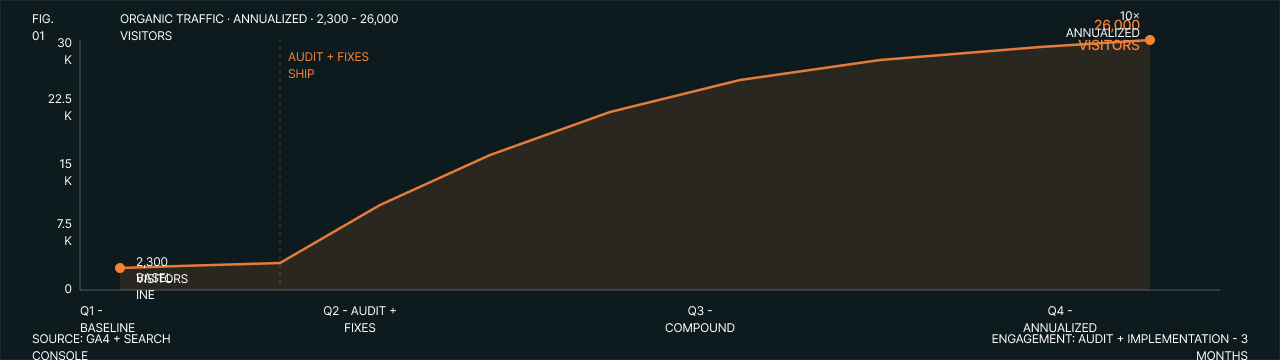
The intervention lands between Q1 and Q2. Everything left of the dashed line is the baseline. Everything right of it is what the fix list produced. Numbers pulled from GA4 + Search Console, reconciled against HubSpot attribution.
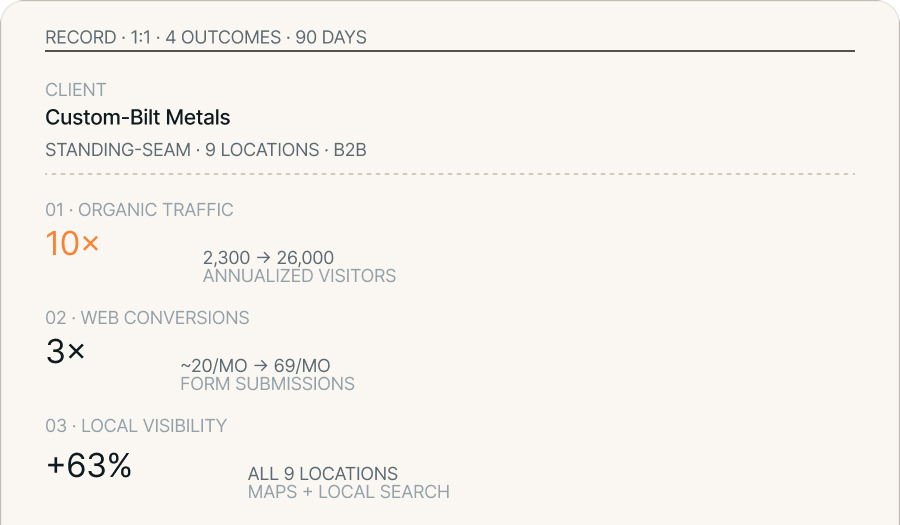
Organic traffic. 2,300 → 26,000 annualized visitors. 47% of total site traffic.
Web form submissions tripled in 90 days. 207 submissions in the quarter. 24% auto-converted to deals.
Local visibility across all nine locations. Branch-level pipeline became measurable for the first time.
Every CRO engagement has three sections: the setup, the work, and the result. This one is written in that order, with the caveats added at the end.
Custom-Bilt Metals sells standing-seam metal roofing, siding, and architectural panels through nine locations across the US. Their buyers split three ways: contractors, architects, and homeowners, researching a long-cycle, high-consideration purchase. The site needed to convert all three. It wasn’t.
When the engagement started, the site was pulling 2,300 organic visitors a year. A direct competitor in the same product category and same geography was pulling roughly 12× that traffic with zero paid spend. Custom-Bilt was paying for ads to close the visibility gap and losing the conversion battle anyway, 2.7:1.
The site wasn’t broken in any obvious way. The homepage hero had no value proposition. The H1 was buried halfway down the page. Product pages listed specs but didn’t address the questions buyers actually asked on sales calls. Location pages were glorified contact cards. Nine branches, no measurement stack, no way to tell any of them apart.
The sequence matters. Every phase below depended on the one before it. Skip the measurement stack and every architecture decision becomes a guess; rebuild architecture without new copy and the site still won’t convert.
GA4, Microsoft Clarity, phone-click tracking, HubSpot forms across all nine locations. Cross-location attribution. Conversion goals tied to sales-qualified events, not vanity form fills. The unglamorous half of CRO that gets skipped on most engagements. Also the half that determines whether anything else works.
Persona-specific CTAs for contractors, homeowners, and architects on every page where the buyer has to self-identify. Cut the primary conversion path from four clicks to two. Rewrote the H1/H2 hierarchy for both SEO and human readability. Aligned product page messaging with the sales battlecard so the page answered the same objections the sales team was already answering on calls.
Google Business Profile cleanup and optimization for every branch. Structured data for local business across all nine. Consistent NAP data sourced from the HubSpot record so branch-level changes only had to happen once. Local landing pages rebuilt from contact-card templates into actual conversion pages.
Traffic: 10× in 90 days. Organic visitors went from 2,300 a year to an annualized 26,000. Organic search now drives 47% of total site traffic. The competitor with 12× the traffic at the start was caught within the measurement window.
Conversions: 3× web form submissions. Roughly 20 form submissions a month at the start, 69 net new leads a month by end of Q1. 207 form submissions in the quarter. 24% of those auto-converted to deals in the CRM.
Local visibility: +63% across all nine locations. Local search views up 63%. More calls, more directions requests, more clicks from Google Business Profile. Branch-level pipeline contribution became
The same three things show up on almost every B2B site that lands on the intake form. If any of them sound familiar, the same fixes probably work.
Half the engagements I run start with analytics that can’t answer basic funnel questions. Fix that first or every other decision is a guess. The Custom-Bilt measurement rebuild happened before a single copy change was drafted.
“Contact us” is what a brochure says. “Get a contractor quote” is what a contractor clicks. The rewrite is often trivial; noticing it needs rewriting is the work.
Custom-Bilt didn’t relaunch the site. We rebuilt how it converts. The visual design barely changed. The numbers changed by 10×. Most “redesigns” move pixels around without touching the thing actually driving conversion.
A CRO Audit ($3,500, 5 days) finds where conversion is lost and gives you a prioritized fix list. A GEO Audit ($3,500, 7 days) does the same for AI search visibility. Scoped CRO engagements are the first step to find revenue leakage and missed conversion opportunities.