
AGENTIC WORKFLOWS · SCOPED CASE BY CASE DWG · 05 / 06 · PRACTICE

Give your team's skilled hours back to the work only they can do.

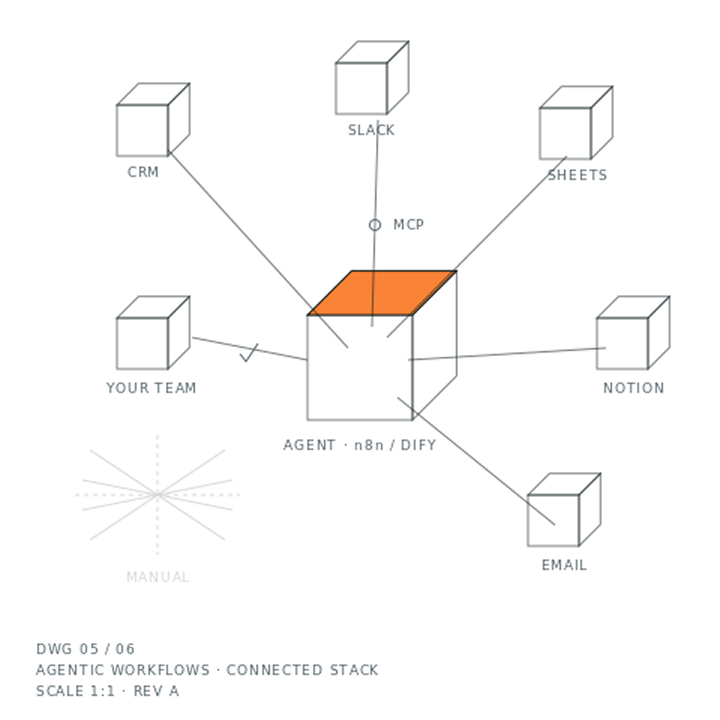
The repetitive work that moves data between the tools you already license is doing what software should do, on payroll that should be doing judgment work.  

Built on n8n, Dify, Claude, and the APIs your stack already exposes. Two to eight weeks, scoped on a 30-minute fit call. 

P.01 · SHAPE 01

Workflow Automation (n8n)

P.02 · SHAPE 02

AI Agents (Dify)

ALL SHAPES

2–8 weeks · one person

A-02 · WHERE THE OUTPUT GOES

You do not need another tool. You need the work between the tools you already license taken off your team.

A senior person is the glue between four systems.

The instinct is to buy a chatbot or another tool. The loss is not there. It is the senior person who is the glue between four systems, copying fields between the CRM and the email platform and reconciling by hand a report that should arrive built. The honest reason it is still manual is that nobody has had time to fix it. The cost is a payroll producing less than it could, every week.

The spec is the thing you buy first.

The work starts with a written spec, not a build. I write down the whole workflow before anything ships: each step, each input, and the points where a human has to decide. You read it before a line is built. Irreversible actions stay gated behind human review. There is no black box to trust, because the spec is the thing you are buying first. That discipline is the proof here, in a lane too new for a case-study wall.

One workflow, with the decision date written down.

The result is the back office running with less hand-holding and skilled hours back on the judgment work you actually hired for. The first engagement is one workflow, scoped on a fit call, with the success test and the decision date written down before the build starts. Send a URL and a sentence about the workflow that eats the most hours, and the fit call tells you whether it is worth specifying, including a recommendation against it if the honest answer is no.

Send a URL and a quick sentence.

Send a short email with your URL and one sentence about the process you’d want to automate or the documents you’d want an agent to check before it answers. A fit assessment and a proposed call come back within 24 hours. 30-minute fit call. Scoped proposal with a fixed price before any work starts.

A-03 · DETAIL DRAWINGS · FIG. 03

Two shapes. Each scoped to where the work actually breaks.

Every engagement is scoped on a fit call. These are the two shapes that come up most often, ordered by how much specification and judgment each one carries. Volumes are drawn roughly to relative duration and complexity.

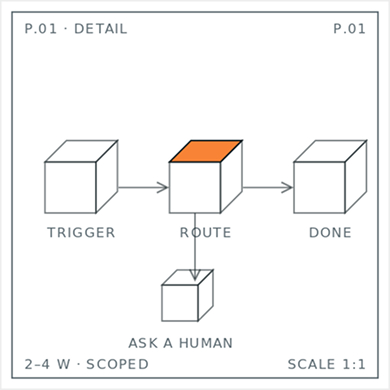
P.01 · ENGAGEMENT SHAPE 01

Workflow Automation.

Connect the systems your team already uses so information arrives, actions route, and approvals close without a person rebuilding the same report every Monday. Built primarily in n8n, with direct API integrations and Dify for any LLM-enabled step. The kind of work where the honest answer to why are we doing this by hand is nobody has had time to fix it.

DURATION

2–4 weeks

RANGE

Scoped on a call

STACK

n8n · APIs · Sheets / Notion / CRM

BEST FIT

People as glue between tools

Recent shape: a newer practice line. Early automations are in build now, like a Monday-report pipeline pulling a CRM, a billing platform, and a shared sheet into one flagged view. Named write-ups publish as engagements complete and clients approve them.

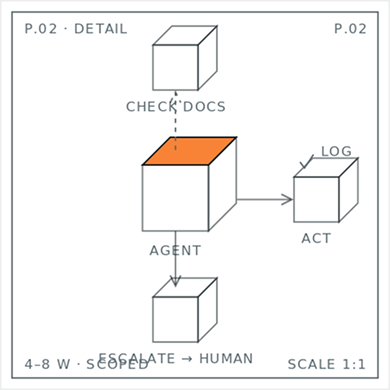
P.02 · ENGAGEMENT SHAPE 02

AI Agents.

Agents that handle routine decisions and know when to stop and ask a human, with every action logged so the person reading it at 2am can tell in seconds whether to accept or override. When an agent needs a fact from your own documents, it can look it up and flag when it isn’t sure rather than guess. Built on Claude for reasoning-heavy work, OpenAI where cost or latency favors it, with tool calls scoped to exactly what the agent is allowed to do. Authority boundaries, escalation paths, and the human-facing log get specified before the build.

DURATION

4–6 weeks

RANGE

Scoped on a call

STACK

Claude · OpenAI · n8n · Dify · scoped tool calls

BEST FIT

Routine decisions that affect real work

Recent shape: agent work is the newest part of this practice, so the proof is method and stack more than a named client roster yet. Illustrative shape: a triage agent with bounded authority, a visible action trail, and an escalation path that actually fires.

A-04 · CADENCE · FIG. 04

One person handles the engagement end to end.

Investigation, specification, build, calibration. No handoffs between a strategist who scopes and a developer who builds. The person who maps the workflow is the person who wires the n8n nodes and tunes the agent.

WEEK 1

Investigate

Shadow the work as it actually happens. Name every handoff, every waiting period, every shadow spreadsheet, and every judgment call the automation will face.

Output · A current-state map of the workflow and the three to five points where automation, an agent, or retrieval is worth the build.

WEEKS 2–3

Specify

Write down what triggers each step, what the agent decides on its own, what it escalates, and what a person sees when it acts. Walk the last 90 days of edge cases against that definition before anything gets built.

Output · A build-ready specification, precise enough that the build is the straightforward part.

WEEKS 4–6+

Build & Calibrate.

Wire it in n8n, Dify, and Claude, with tool calls scoped and irreversible actions gated. Then validate against how people actually work and tune the thresholds the live system reveals.

Output · A working, calibrated system on your stack, with action logs and fallbacks built in, and a short note on what to watch as the work and the models keep changing.

A-07 · PRE-KICKOFF

What usually comes up before the first call.

Four questions that land on every Agentic Workflows fit call. Short answers here; the full ones happen on the call.

Q.01
Do you build it, or just design it?

Build it, end to end. The person who specifies the workflow is the person who wires the n8n nodes, scopes the agent's tool calls, and tunes the retrieval. No spec gets thrown over a wall to a separate build team.

Q.02
What about data security and our existing stack?

The build sits on your stack and integrates through the APIs and tools you already use: SharePoint, Notion, Sheets, your CRM. Deployment is AWS-first, alternative clouds when your stack demands. Nothing gets accessed without a signed data-handling agreement, and irreversible actions stay gated behind human review unless the spec explicitly authorizes otherwise.

Q.03
Start with an audit or go straight to a build?

If you already know what the workflow is and you want it scoped and built, go straight to the fit call. If you're not sure where the problem actually lives, the fit call itself is usually enough to tell you, and it doesn't commit you to anything. Either way you'll get a straight read on whether a build is even the right move.

Q.04
Is this a good fit?

Your people are the connective tissue between four systems, and the honest reason it's manual is that nobody has had time to fix it. You have real institutional knowledge trapped in files nobody searches, and your team loses time guessing at answers that already exist. You tried a chatbot or a zap, it broke on the cases that matter, and you suspect the problem is upstream of the tool.

A-08 · READY WHEN YOU ARE

Send a URL and a sentence. 24-hour fit assessment.

Send a short email with your URL and one sentence about the process you’d want to automate or the documents you’d want an agent to check before it answers. A fit assessment and a proposed call come back within 24 hours. 30-minute fit call. Scoped proposal with a fixed price before any work starts.

Send a URL

One page, one sentence. I’ll reply with the first few things I’d fix, usually within a day.

    Start a project

    Pick what you are starting and where. I will come back with scope and a kickoff date.